 Vietnamese
 English






For many students, Political Education has often been associated with long theoretical lessons, difficult concepts, and the feeling of “studying only for exams.” Many people consider it a dry subject that lacks practicality and fails to inspire interest. However, in recent years, the teaching and learning methods of Political Education have changed significantly, making the subject more engaging, relatable, and meaningful to young people.
GDVN – This is one of the important new regulations aimed at ensuring accuracy, synchronization, and verification capability within the national digital system.
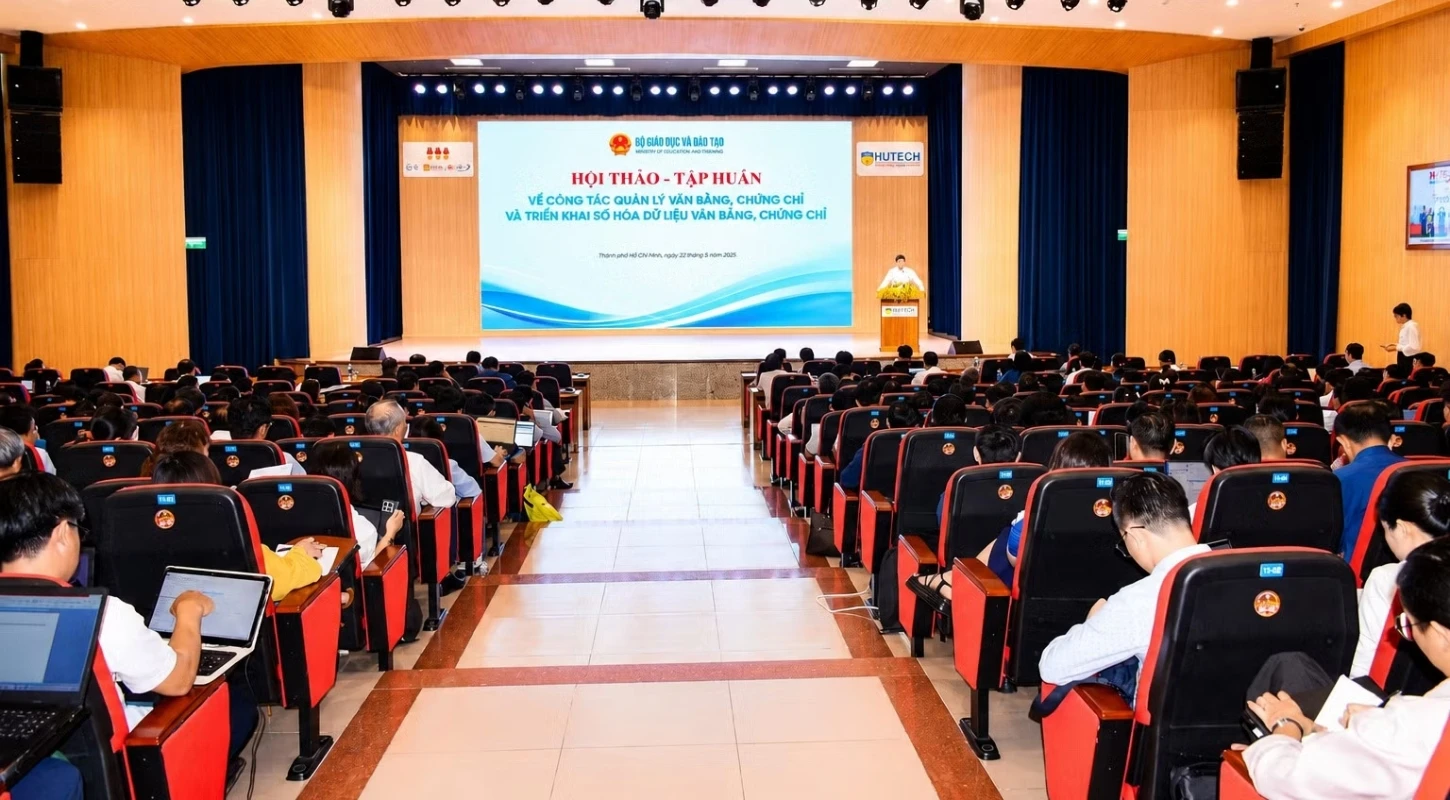
On May 22, in Ho Chi Minh City, the Ministry of Education and Training, in coordination with HUTECH University of Technology Ho Chi Minh City, organized a training workshop on the management and digitalization of diploma and certificate data.

The workshop was attended by leaders of the Quality Management Department (Ministry of Education and Training), the Department of Science, Technology and Information (Ministry of Education and Training), the Project Management Board, along with 600 delegates who are leaders and key officials from Departments of Education and Training, higher education institutions, and vocational education institutions in Southern Vietnam.
This marks an important step toward disseminating the new regulations and guiding the implementation of digitalization software systems, thereby contributing to the modernization of diploma and certificate management in the digital era.
Enhancing Autonomy and Responsibility in the Management of Digital Diplomas and Certificates
In his opening speech, Huynh Van Chuong stated that 2026 is a particularly significant year for diploma and certificate management, as the Ministry of Education and Training issued Circular No. 10/2026/TT-BGDĐT dated February 26, 2026, promulgating the Regulations on Diplomas and Certificates within the national education system.
The new regulations institutionalize amendments and supplements to the Law on Education, the amended Law on Higher Education, and the amended Law on Vocational Education. At the same time, they promote decentralization and grant greater autonomy to educational institutions while strengthening accountability, transparency, and public disclosure throughout the process of managing and issuing diplomas and certificates.
According to Mr. Huynh Van Chuong, from 2026 onward, universities, colleges, intermediate schools, and high schools nationwide will move toward digitally signing diplomas before signing and issuing paper versions, ensuring accuracy, synchronization, and verification capability on the national digital system. Previously, the Ministry piloted this initiative with more than one million digital high school graduation diplomas.
The development of a digital diploma database serves not only the management needs of the education sector but also represents a key task under the Government’s Project 06 on developing applications of population data, identification, and electronic authentication to support national digital transformation for the 2022–2025 period, with a vision toward 2030. All digital diploma data will gradually be integrated into the VNeID platform, allowing citizens to use them directly for recruitment, education, document verification, and administrative transactions without presenting paper copies.
The Director General also emphasized that digitized diploma and certificate data must adhere to the principles of being “accurate, complete, clean, live, unified, and shared,” ensuring absolute accuracy and authenticity compared to original paper records. In addition, digitalization must strictly comply with regulations on personal data protection, information security, cybersecurity, and data storage infrastructure located within Vietnam.
Besides granting autonomy to educational institutions in designing, managing, and issuing diploma templates, the Ministry of Education and Training also requires heads of institutions to take full responsibility for the accuracy and legality of issued diploma data. The Ministry will conduct supervision and cross-check input and output data through centralized management software systems to promptly detect irregularities in diploma and certificate issuance.
Determination to Implement Digital Diploma Issuance in 2026
According to Le My Phong, from January 1, 2026, three amended laws - the Law on Education, the Law on Higher Education, and the Law on Vocational Education - officially take effect, bringing many important changes related to the diploma and certificate system.
A notable new point is that, for the first time, the law clearly stipulates that paper diplomas and digital diplomas have equal legal validity. In addition, from 2026 onward, lower secondary school graduation diplomas will no longer be issued, and the concept of an “equivalent qualification diploma” will be replaced with “a diploma for specialized in-depth training programs.”
Under Circular No. 10/2026/TT-BGDĐT on Regulations for Diplomas and Certificates in the national education system, many practical shortcomings have been addressed, such as digital diploma management, decentralization of signing authority, reduction of verification procedures, and enhancement of institutional autonomy. Under the new regulations, the Ministry will no longer directly supply diploma templates; educational institutions will bear full responsibility for printing, managing, and issuing diplomas and certificates under their authority.
Another highlight is the development of a centralized nationwide diploma and certificate database. The Ministry of Education and Training plans to integrate diploma data into the VNeID platform to support electronic authentication, significantly reduce administrative procedures, and eliminate the prolonged manual verification process that has persisted for many years. Once the system is completed, information extracted from the database will hold the same legal validity as the original diploma issuance register.
At the same time, the Ministry requires educational institutions to urgently digitize previously issued diploma and certificate data, especially for learners graduating from 1970 onward. The digitization process consists of five steps, in which data entry, inspection, and verification must ensure absolute accuracy and authenticity compared with original records. The Ministry also recommends that institutions strengthen review procedures to minimize errors during digital transformation.
At the conference, experts presented, guided, and discussed many important issues related to the implementation of diploma and certificate regulations, management practices, and the installation, operation, and utilization of diploma and certificate digitalization software systems.
The conference also addressed numerous questions regarding new points in the Regulations on Diplomas and Certificates issued under Circular No. 10/2026/TT-BGDĐT; the responsibilities and authority of agencies and institutions in diploma and certificate management; the digitization process and technical requirements for information security and data protection; and the organization, management, operation, and exploitation of the diploma and certificate database system.
Source: https://giaoduc.net.vn/tu-nam-2026-cac-truong-phai-ky-so-van-bang-truoc-khi-cap-ban-giay-post260081.gd